Maps and rooms / GUIDE 08
Finding Your Way When Every Corridor Looks Familiar
You change floors, walk into a room, and realize you are looking for the downstairs sofa in the upstairs bedroom. The two floors share a similar overall shape, which makes this an easy mistake. Instead of memorizing a complicated map, learn the central corridor, the transport end, and one memorable feature in each room. Those landmarks give you a simple way to recover whenever the close camera makes the house feel unfamiliar.
Use the corridor as your home base
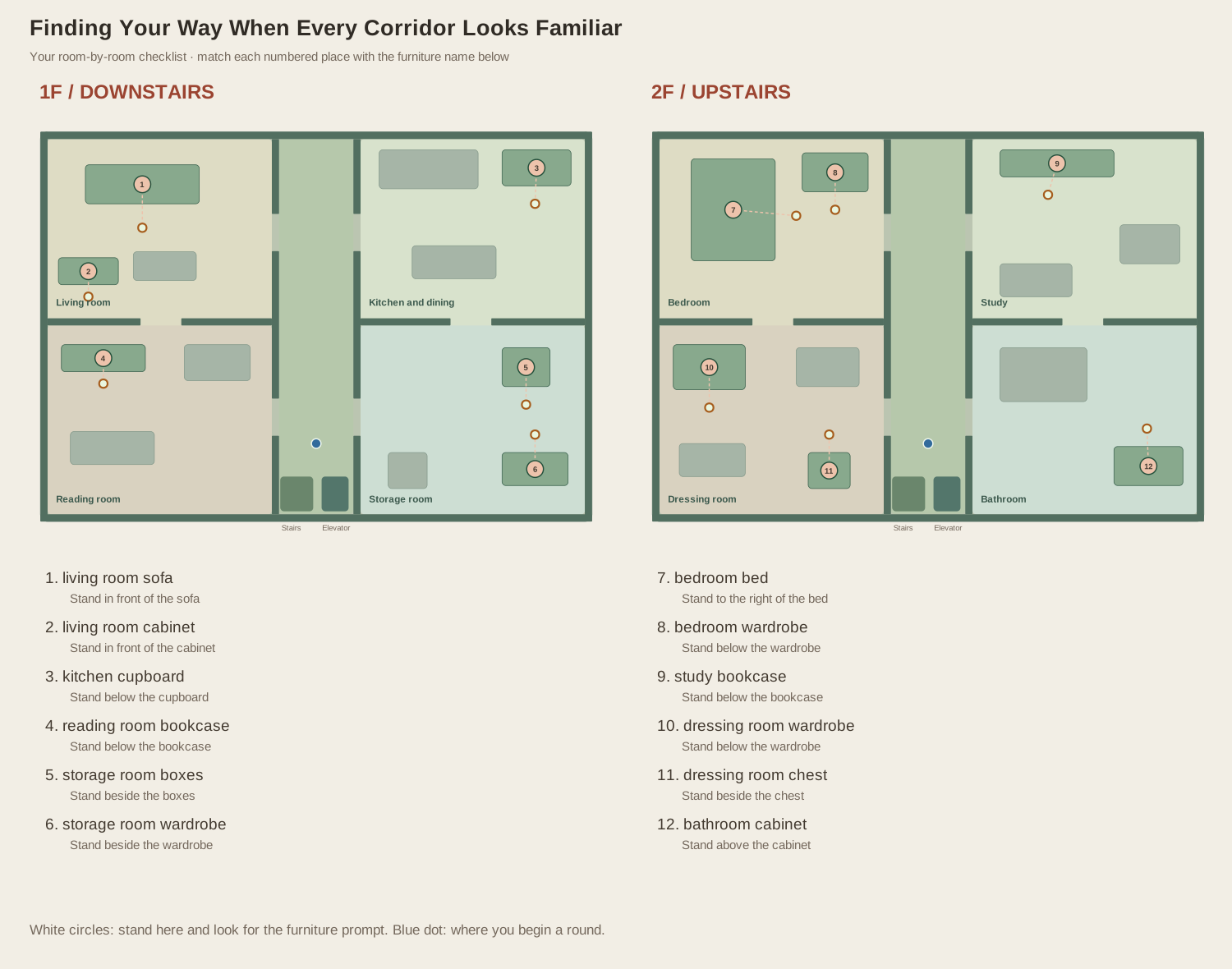
A long corridor runs through the middle of each floor. Rooms sit to the left and right, with openings that you can walk through. You do not need a key, a door button, or an F interaction to enter a room. If you get stuck beside a wall, move toward the visible gap rather than pressing F at the doorway.
At the bottom of the corridor, stairs sit on the left and an elevator sits on the right. They are the easiest landmarks to recognize on either floor. When you become uncertain, return to that area, check the floor label, and head north toward your next room. Moving from one known place is usually quicker than making several uncertain turns around furniture.
Recognize downstairs by its everyday rooms
Downstairs has the living room in the upper left and the kitchen and dining room in the upper right. The lower-left room is the reading room, and the lower-right room is storage. The large living room sofa, kitchen table, reading room shelves, and storage boxes make useful visual reminders, even though not every memorable object is a hiding place.
For searching, remember the downstairs room totals: two spots in the living room, one in the kitchen, one in the reading room, and two in storage. That gives you six altogether. Once you know those totals, you can decide whether a room is complete without looking at every corner twice. The furniture prompt tells you which specific place you are checking.
Recognize upstairs by its private rooms
Upstairs replaces those rooms with a bedroom, study, dressing room, and bathroom. The bedroom is upper left, the study upper right, the dressing room lower left, and the bathroom lower right. A large bed and a bath make this floor especially easy to recognize. If you see either, stop looking for the downstairs living room or storage boxes.
The upstairs totals are two spots in the bedroom, one in the study, two in the dressing room, and one in the bathroom. The bath itself is not a hiding place; the bathroom cabinet is. Likewise, the study desk is not a substitute for its bookcase. Use the room landmarks to find your way, then use the named prompt to choose an action.
Recover after a wrong turn
Suppose you enter the bathroom when you meant to reach storage. Check the floor label first. If it says 2F, you are on the wrong floor rather than simply at the wrong side of a room. Return to the lower corridor and make one deliberate floor change. After arrival, move away from the stairs so you do not accidentally travel back while still holding a downward key.
For a gentle orientation exercise, start a one-hider search and visit each downstairs room before going upstairs. Say the room names as you enter them, and notice the connections between the upper and lower rooms on each side. You may find the hider before completing the tour; that is fine. Try the remaining rooms next time. Familiarity grows from short, recognizable journeys, and soon a missed turn becomes a small correction rather than the reason you lose the whole round.