Getting started / GUIDE 03
Getting the Right Action When You Press F
You reach a piece of furniture and press F, but your character leaves a hiding place instead of entering another one. Or you stand near the bottom of the corridor and change floors when you meant to search. F handles several useful actions, so the key to reliable play is to read the short prompt before pressing it. That prompt tells you what your character is ready to do from the current position.
Start with what your character is doing now
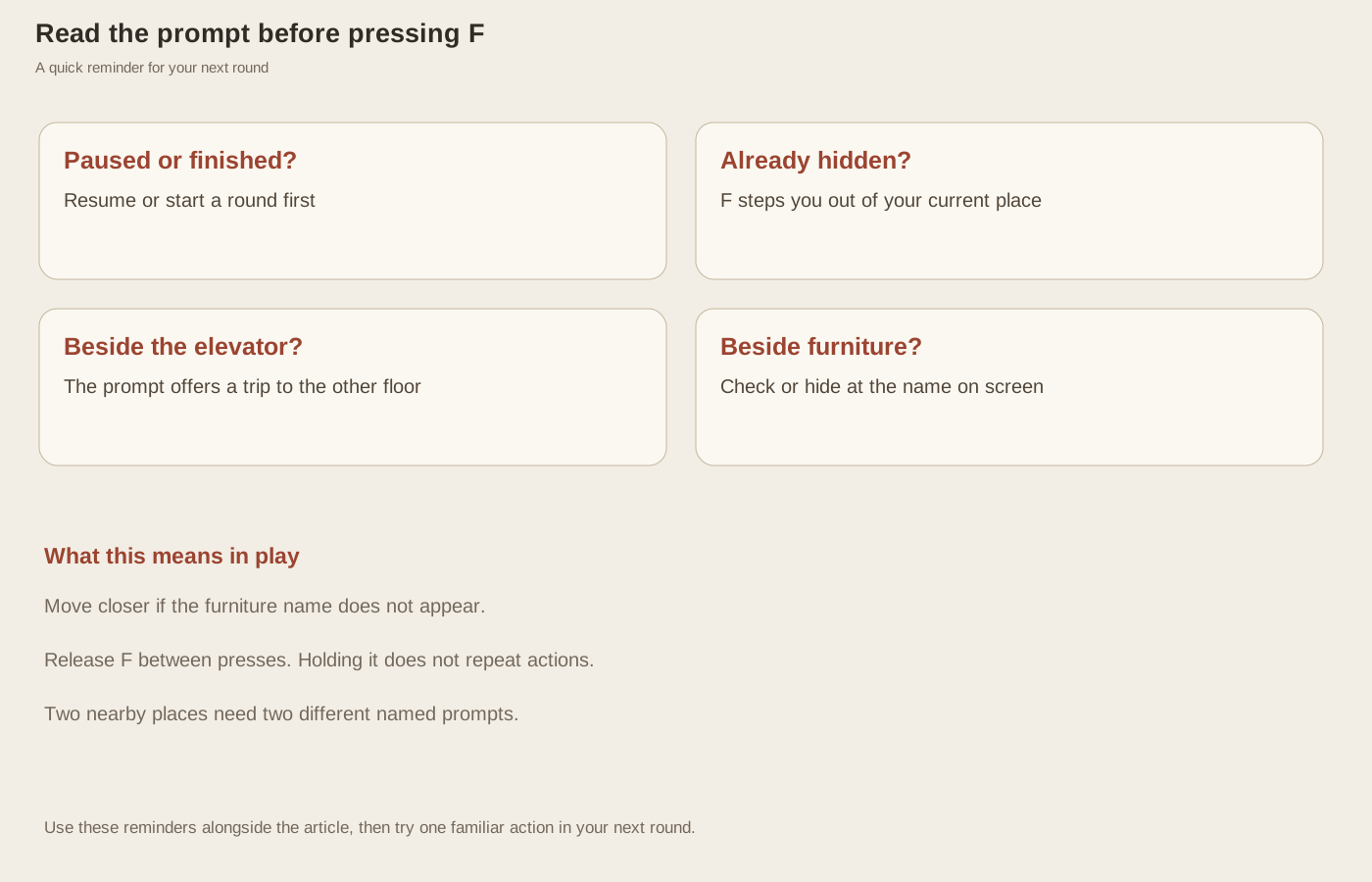
F works during an active round. If the pause screen is open, resume before trying to search or hide. If the round has already ended, choose another round rather than attempting to interact with the scene behind the result. Taking a moment to check the screen avoids repeated presses that seem to do nothing because you are not currently playing.
When you are hidden, the next F press always means leave. Your character steps out beside the furniture, and the Hidden status disappears. That first press does not also put you inside a second spot. Leave, look at the new prompt, then make the next decision. This is particularly useful when two hiding places sit close together, such as the boxes and wardrobe in storage.
Check the name beside nearby furniture
In a seeker round, look for a prompt beginning with “Check.” In a hiding round, look for “Hide at.” Both name the specific furniture that will respond. Move toward the clear standing area beside the object until its name appears. If you are at the far side of a large sofa or bed, walking around to another side may be enough to reveal the correct prompt.
If two spots are close together, small movements can change the name. Suppose you have just checked the storage boxes and want the wardrobe. Do not simply press F again from the same place. Step closer to the wardrobe and confirm that the wording has changed. Two key presses are not necessarily two different searches, and reading the name prevents an easy missed spot.
Give the elevator its own moment
The elevator sits on the right at the bottom of the corridor. Stand near it, wait for the elevator prompt, then press F. If that prompt is showing, the key will try to use the elevator rather than search furniture. Move away from the transport area if your intention is to interact with a room's hiding place instead.
After changing floors, allow the arrival to settle before trying another trip. Move north into the corridor and confirm the floor label. You do not operate the stairs with F: walking onto them is enough. Keeping these two actions separate makes floor changes predictable and prevents repeated key presses from turning a simple journey into confusion about which floor you occupy.
Use a calm entry and exit routine
Try this during the preparation time in a one-seeker hiding round. Approach a familiar spot, read its name, press F, and confirm Hidden. Release the key. Press F again to leave, then move away until the furniture prompt disappears. Return and enter once more. The routine gives you a clear feel for the difference between standing nearby, being hidden, and leaving.
Hold movement keys when you need continuous travel, but use separate F presses for interactions. Holding F does not keep searching or repeatedly change your hiding state. Once you have learned that rhythm, it becomes easier to respond under pressure: move, read, press, confirm. You can use the same rhythm for every hiding place in the house, without memorizing technical distances or guessing whether your character's picture overlaps the furniture enough.