Everyday help / GUIDE 30
Answers to the Questions That Come Up During Play
You do not need to learn every rule before your first round. Some questions only make sense after you have missed the last hider, been found behind a table, or tried to continue a match after refreshing the page. This guide brings those everyday questions together so you can choose the next useful action. The answers focus on what you can see and do while playing rather than on how the game is made.
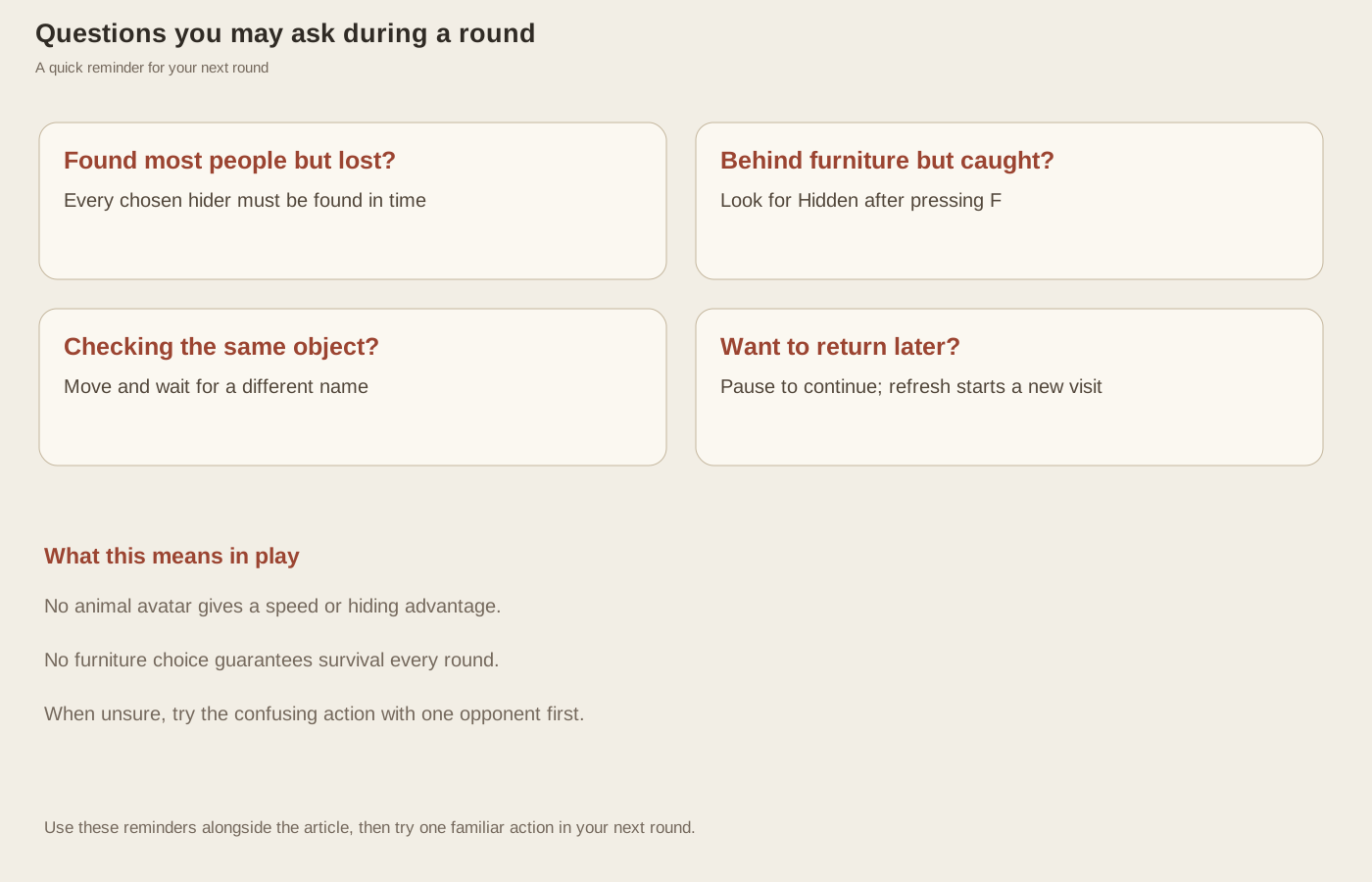
Why did I lose after finding several people
In seeker mode, you need to find every chosen hider before the two-minute search ends. Finding four out of five is progress, but it is not a win. Read the result for the places that remained unchecked or undiscovered. Those names can reveal that you skipped one wardrobe in a room you otherwise searched or never reached the other floor at all.
You can make the task simpler on the next attempt by choosing fewer hiders. There is no requirement to keep the largest count. If the final discovery ends a round before you finish your planned tour, that is a win: you do not need to check unused places afterward. The found total is a better guide to completion than whether your personal route has reached its final room.
Why was I found when I was behind furniture
Standing behind a table, desk, or bath is not the same as entering a hiding place. Look for a named “Hide at” prompt, press F, and confirm Hidden. Your character becomes faded when the action succeeds. That picture helps you locate yourself; it does not mean you are partly discovered or that you should immediately leave.
While you are hidden, a seeker can find you by checking the place you occupy. If you are outside a spot, being near a checking seeker can also get you caught. Read the loss message to distinguish those situations. The response is different: hiding earlier helps with exposure mistakes, while a better-timed decision may help when your actual spot is about to be inspected.
Why does F check the same place again
Nearby hiding places can both be close enough to interact with, especially in storage and the bedroom. Move toward the one you want and read the name in the prompt before pressing again. Holding F is not an automatic repeated search. Release the key between actions and make sure that the target name changes when your intention changes.
If you are already hidden, F leaves your current place first. You then need another deliberate action to enter a new one. Near the elevator, the prompt may offer travel instead of furniture interaction. Step away if you meant to search a room. These habits are more dependable than trying to make a rapid sequence of presses work without looking at the screen.
Can I make a spot permanently safe or save my round
No hiding place is guaranteed to stay unchecked. A seeker can revisit furniture, and another seeker may inspect somewhere you just watched a different opponent leave. Going upstairs changes your options, but seekers can reach both floors. Use the room guides to learn routes and exits rather than expecting one furniture choice to solve every round.
Pause preserves the current attempt while the page stays open, but refreshing or closing the page does not save an unfinished match. Returning to the menu lets you change your role, count, or avatar for the next round. Animal choice and personal pictures do not alter the challenge, so choose the face you like. When in doubt, return to a one-opponent round and practice the specific action that confused you. One clear success is often the quickest way to turn an uncertain rule into something you can use naturally.