Everyday help / GUIDE 27
A Structured Practice Plan for Both Roles
Repeated rounds become more useful when each attempt tests one skill. Villa Hide & Seek randomizes hiding assignments and AI inspection orders, so a single win or loss does not isolate every cause. A short practice plan helps you distinguish your own navigation and interaction errors from the changing round setup. The following drills use existing menu options and ordinary controls; they do not require debug commands, modified files, or a particular random seed.
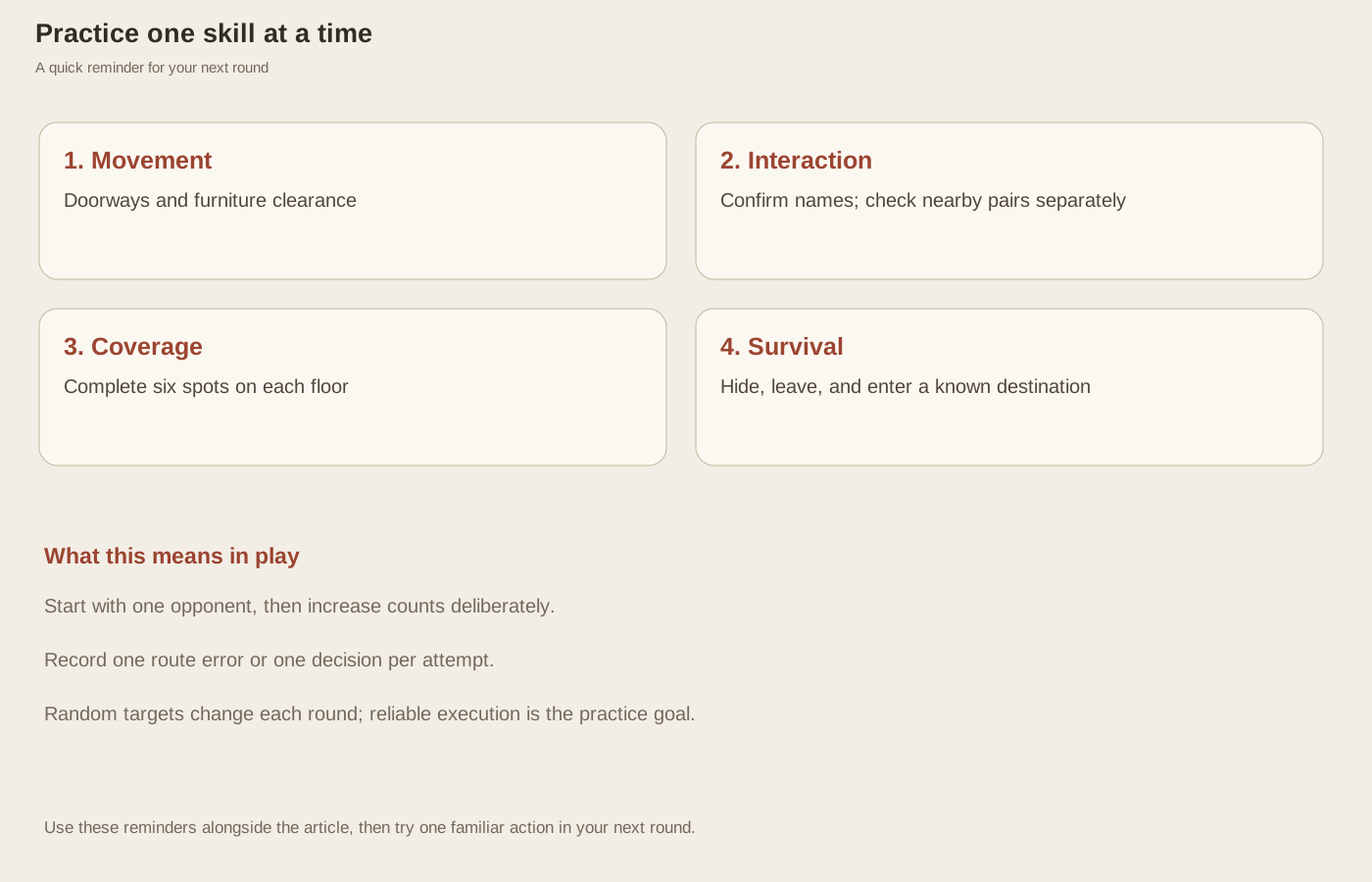
Start with movement and interaction accuracy
Choose a one-hider seeker round. Walk from the initial corridor to the reading room bookcase, reach its named prompt, and press F once. Whether you find the hider is irrelevant to this drill. The success condition is reaching the correct approach, completing the interaction, and returning through the corridor opening without repeatedly colliding with the desk or wall. Restart if an early discovery ends the round before you finish the movement exercise.
Next practice a nearby pair, such as storage boxes and wardrobe. Check one, move until the prompt names the other, and check again. Your success condition is two different targets rather than two F presses. This teaches the nearest-approach rule directly. A repeated check at the same spot is not a failure of input registration; it means your position still selects that same approach.
Add reliable floor changes
Use a new round to practice one stair transfer and one elevator transfer. For stairs, move into the lower-left transport region without pressing F. After arriving, move north away from the trigger and confirm the floor label. For the elevator, stand in its range and press F once. Again confirm the destination floor, then leave the pad area before planning another movement.
The drill succeeds when you can choose the method intentionally and avoid an accidental return trip. This matters because a held downward input after a stair arrival can carry you back into the trigger once the transition cooldown ends. Do not measure success by how quickly the scene changes. Measure whether you know which floor you occupy and where your next room entrance is.
Build full search coverage
Practice clearing all six downstairs spots using a fixed room circuit. If the match ends before completion, start another and continue the coverage exercise. Then practice the six upstairs spots in their own circuit. Write the room totals on paper if needed: downstairs two, one, one, two across living room, kitchen, reading room, and storage; upstairs two, one, two, one across bedroom, study, dressing room, and bathroom.
When both circuits feel familiar, increase to five hiders and combine them. Record missed spots from timeout results, duplicate checks, and the room entrances that cost the most attention. Improve one category per attempt. A higher discovery total can indicate progress, but a complete and accurately executed route is the stronger transferable skill because the next round will assign different hiding places.
Practice entering and leaving a spot
Return to one AI seeker and use preparation time to enter a spot, leave it with F, and enter another. Confirm the Hidden status at both entries. This drill succeeds through entering and leaving correctly, not through surviving the entire search. Once reliable, try a full round with no planned relocation and observe the result. Then try one deliberate relocation along a route you have already practiced.
Keep notes concise: role, opponent count, initial spot or route, one decision, and cause of the ending. Increase seekers gradually instead of changing the count, starting floor, avatar, and relocation plan all at once. The avatar is cosmetic, but changing too many real conditions still makes outcomes harder to interpret. These drills build a foundation of reliable controls and map knowledge, allowing later strategy experiments to answer useful questions rather than merely producing another unexplained result screen.