Getting started / GUIDE 06
Player Counts and Practical Difficulty Settings
Villa Hide & Seek lets you change how many AI opponents participate, but it does not expose a conventional Easy, Normal, or Hard selector. The number settings change the task itself. A seeker faces more hiding assignments, while a hider faces more independent searchers. Understanding this distinction helps you choose useful practice conditions and avoids expecting a higher count to unlock new maps, faster movement, or special character powers.
Choose your opponents in the second step
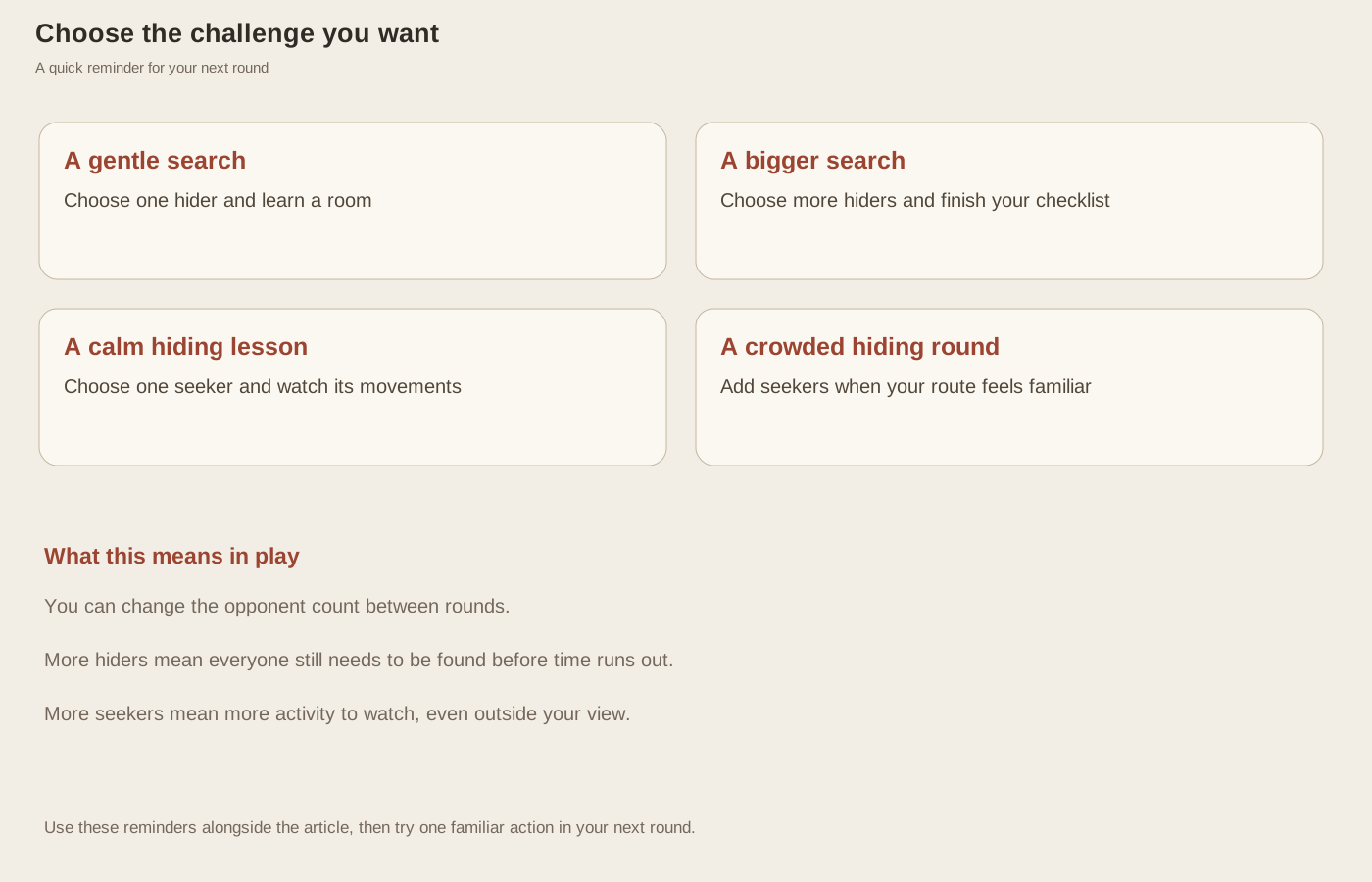
Start by choosing “I'll seek” or “I'll hide,” then click “Next: Opponents.” The second step shows five simple choices, from one opponent to five. If you chose to seek, the number means how many hiders you need to find. If you chose to hide, it means how many seekers will search for you. You are always the only player on your side, so there is no second team size to work out.
The biggest round contains six characters: you and five AI opponents. Read the short reminder beneath the numbers to check your task, then move to the character step. The final summary confirms your role and opponent count before you start. If you change your mind, use Back to revisit the earlier choice. Your selections stay in place, so you can adjust just the one decision without starting the setup again.
What more hiders actually changes
In seeker mode, the game chooses a distinct set of hiding places for the chosen hiders. Two AI hiders do not share the same spot in a round. They remain stationary, so the challenge is finding all assigned places within the same 120-second limit. The player does not receive extra time for increasing the hider count, and a partial clear is still a loss if anyone remains undiscovered when time expires.
More hiders can make early discoveries feel easier because more places are occupied, but the win condition is stricter. Finding four characters in a five-hider round is not equivalent to completing four separate one-hider rounds. The fifth may require you to visit the other floor or a room you skipped. Practice a complete inspection route rather than treating the number of early successes as proof that your route covers the map.
What more seekers actually changes
In hiding mode, extra seekers give you more people to keep track of. They can search different rooms or turn up in the same area, so watching one opponent leave does not explain where the others are. The challenge comes from several searches happening at once. Start with one seeker while learning a route, then increase the number when you can recognize the nearby furniture and make a clear decision without rushing.
The preparation time remains twenty seconds, and the active search remains 120 seconds. With several seekers, the camera may show only some of them because they can be on different floors or outside the visible area. A quiet room is therefore incomplete information. It does not establish that every seeker is far away or that an unobserved place will remain unchecked for a predictable duration.
Build a useful practice ladder
Start seeker practice with one hider until furniture prompts and floor changes feel routine. Move to three hiders when you want feedback on room coverage, then try five when you can clear both floors without repeated checks. These are suggested learning stages, not separate game modes. You may skip directly to five, but your losses will be harder to diagnose if you are still learning which furniture is interactive.
For hiding practice, start with one seeker and learn to hide before preparation ends. Add a second seeker when you can leave and re-enter spots reliably. Progress toward five when you can watch a visible inspection without confusing it with an automatic reason to panic. Keep a small record of the count, starting spot, relocation decision, and outcome. That turns repeated rounds into comparable experiments instead of changing several conditions at once and guessing why the result changed.