Playing with confidence / GUIDE 23
Searching for Five AI Hiders Within the Time Limit
A five-hider seeker round is a coverage challenge. Five distinct places among the twelve usable spots hold characters, and you must find all five before the same 120-second clock expires. Early discoveries can arrive quickly, but the last remaining hider may be in a room you have not visited. The most useful improvement is a complete, repeatable search structure that reduces duplicate checks and unnecessary floor changes.
Set the round and expectations
Choose “I'll seek,” click “Next: Opponents,” and select five. Continue to the character step, confirm the summary, and click “Start playing.” You are the only seeker. There is no extra preparation phase and no time extension for each discovery. Your avatar has the same movement speed and interaction distance regardless of the selected animal. Begin moving toward your planned first room as soon as the round starts.
The five hiding assignments are distinct, so a single furniture check can reveal at most one AI hider. Finding someone does not move the remaining characters or fill newly cleared places. This means your checked list is dependable. Once a spot has been searched, repeating it cannot reveal a hider that walked there later. Once you have checked a place, give your attention to somewhere you have not tried yet.
Sweep rooms rather than chasing guesses
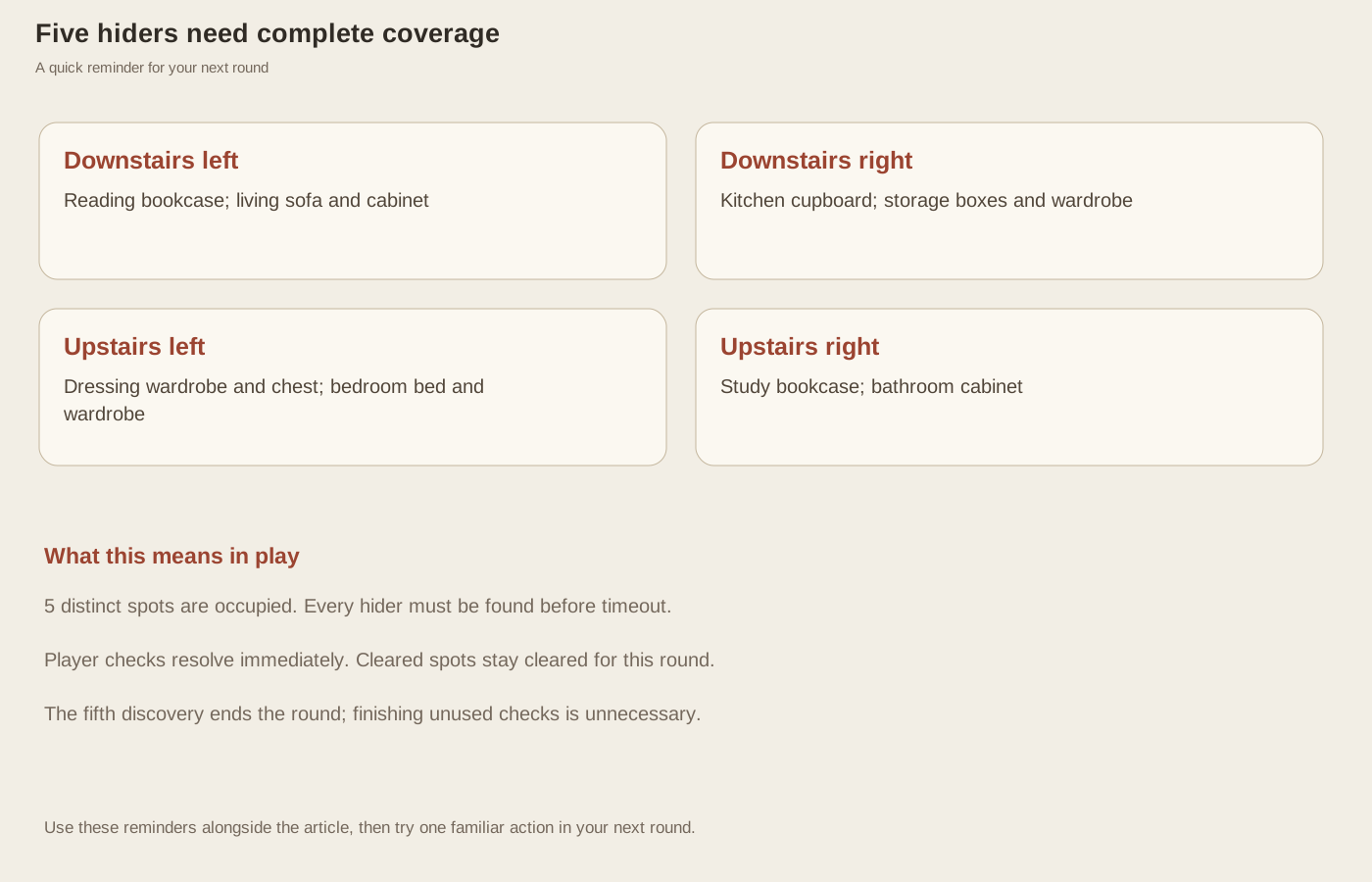
Choose a downstairs circuit that clears each room's full supported list. The reading room needs one bookcase check. The living room needs sofa and cabinet. The kitchen needs its cupboard. Storage needs boxes and wardrobe. Those six actions account for downstairs. The route can begin on either side, but complete both spots in a two-spot room before leaving whenever your path allows it.
Read the prompt at nearby pairs. In storage, the two approaches are close enough that repeated F presses from the same position can recheck the first target. The bedroom pair upstairs creates the same issue. A fast-looking interaction sequence is not useful if it fails to change targets. Confirm each named prompt, press once, then move toward the next marker.
Make the upstairs phase systematic
After a complete downstairs sweep, any undiscovered hiders must be upstairs. Transfer once and confirm 2F. A practical upstairs circuit covers dressing room wardrobe and chest, bedroom bed and wardrobe, study bookcase, and bathroom cabinet. Decorative furniture does not expand this list. Route around the bath and desks without spending search actions on them when no hiding prompt appears.
The game ends immediately when the fifth hider is found. You do not need to finish every unused check after a win. Before that moment, however, do not let a high found count replace room coverage. Four out of five is a useful progress indicator, not a clue that the fifth is nearby. The last assignment can be any unchecked usable spot on either floor.
Find out where your time went
If you time out, read the named remaining positions. A remainder in a room you thought was complete usually indicates an unconfirmed interaction or a mistaken spot list. A remainder upstairs after you never transferred points to routing pace or overlong downstairs exploration. A remainder downstairs after a supposed full sweep tells you to revisit your checklist rather than inventing a relocation mechanic for stationary AI hiders.
For a focused practice session, record only three things: the floor of the last remaining target, any spot you rechecked unnecessarily, and any doorway or furniture corner that stopped your movement. Improve one problem on the next round. This is more actionable than switching avatars or searching for hidden audio clues. The game supplies a small fixed map and immediate player checks, so reliable movement and a clear furniture checklist are the skills that directly support a five-hider win. No single route guarantees it without executing the required travel before the timer ends.